

Meta description: Learn how to start investing as a beginner in 2026 — brokerage accounts, index funds, ETFs, retirement accounts, and a step-by-step plan to build long-term wealth.
Investing can feel overwhelming when you’re just starting out — retirement accounts, brokerages, index funds, ETFs, and a constant stream of market headlines all competing for your attention. The good news: you don’t need to master all of it to get started. This guide covers the core concepts, account types, and a simple step-by-step plan to help you begin investing with confidence.
This article is for educational purposes only and isn’t financial advice. Investing involves risk, including the potential loss of principal, and past performance doesn’t guarantee future results. Consider talking to a licensed financial advisor about your specific situation.
Why Start Investing
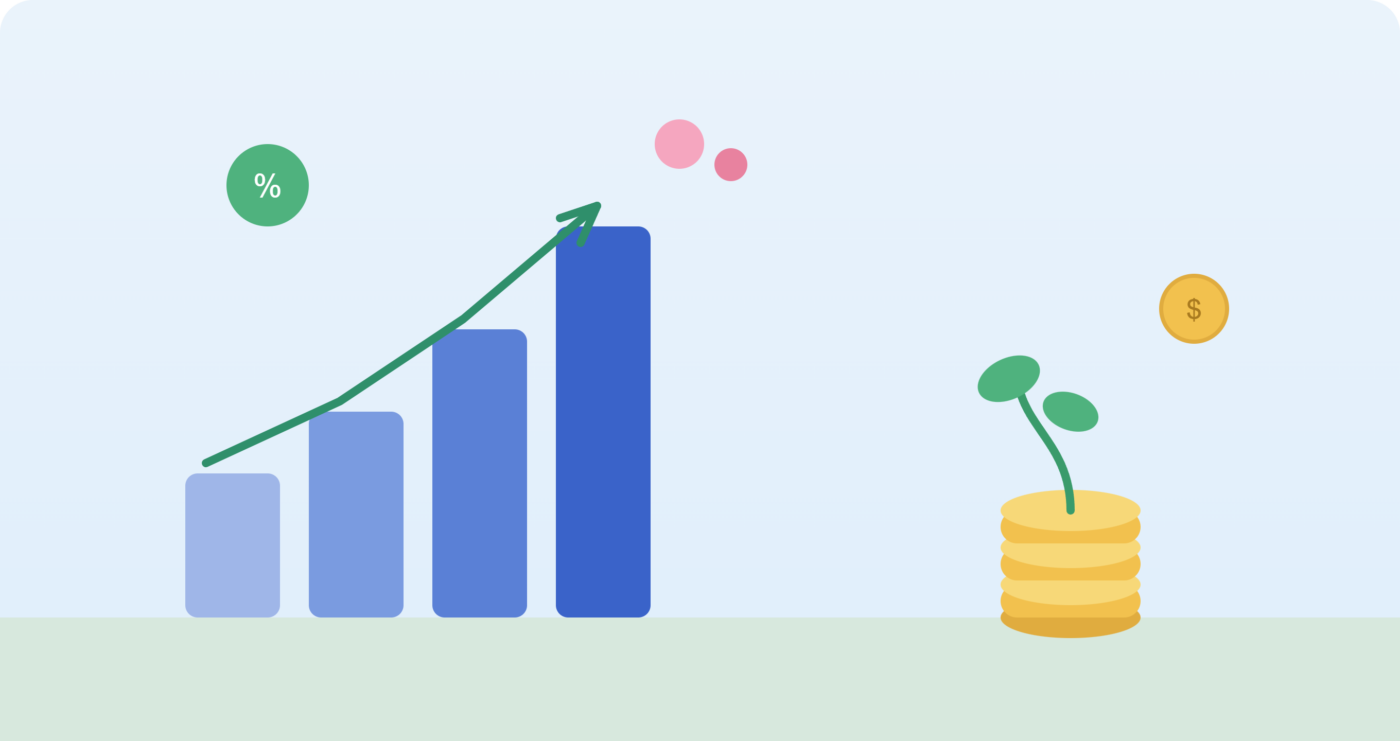
Money sitting in a checking account loses purchasing power to inflation over time. Investing gives your money the opportunity to grow faster than inflation through compound growth — earning returns not just on what you put in, but on the returns you’ve already earned.
The earlier you start, the more time compounding has to work. As an illustration: contributing $300 a month starting at age 30, assuming a 10% average annual return, could grow to roughly $1.97 million by age 65 — from about $126,000 in total contributions. That gap between what you put in and what you end up with is the effect of compounding over decades. (This is a hypothetical example for illustration, not a guarantee — actual returns vary and can be negative in any given year.)
Key Concepts to Understand First
Risk and return. Generally, investments with higher potential returns carry higher risk of loss, especially in the short term. Stocks have historically outperformed cash and bonds over long periods, but they’re also more volatile year to year.
Diversification. Spreading your money across many different investments reduces the impact of any single one performing badly. Owning one stock is risky; owning a fund that holds thousands of companies is far less so.
Time horizon. Money you’ll need in the next 1–3 years generally shouldn’t be in the stock market, since a downturn could force you to sell at a loss. Money you won’t need for 10+ years has more time to recover from volatility.
Dollar-cost averaging. Investing a fixed amount on a regular schedule (like every payday) rather than trying to time the market. This smooths out the effect of market ups and downs and removes the pressure of guessing the “right” time to invest.
Types of Investment Accounts
| Account type | Best for | Key feature |
|---|---|---|
| Taxable brokerage account | General investing, no restrictions | No contribution limits; dividends and gains are taxed |
| Traditional IRA | Retirement savings | Contributions may be tax-deductible; withdrawals taxed in retirement |
| Roth IRA | Retirement savings | Contributions are after-tax; qualified withdrawals are tax-free |
| 401(k) / employer plan | Retirement savings through work | Often includes employer matching — effectively free money |
For 2026, the IRA contribution limit is $7,000 per year ($8,000 if you’re 50 or older). If your employer offers a 401(k) match, contributing at least enough to get the full match is generally one of the highest-value moves available, since it’s an immediate return before any market gains.
Common Investment Vehicles
- Individual stocks — Ownership in a single company. Higher potential reward, but concentrated risk since your outcome depends entirely on that one company.
- Index funds — Mutual funds that passively track a market index (like the S&P 500 or total U.S. stock market) rather than trying to beat it. They tend to have very low fees and instantly diversify you across hundreds or thousands of companies.
- ETFs (exchange-traded funds) — Similar to index funds but traded like a stock throughout the day. Many ETFs track the same broad indexes and are known for low expense ratios, often well under 0.10% annually.
- Bonds — Loans to a government or corporation that pay interest over time. Generally lower risk and lower return than stocks, and often used to add stability to a portfolio.
- Target-date funds — A single fund that automatically adjusts its mix of stocks and bonds to become more conservative as you approach a target retirement year. Popular in 401(k) plans for hands-off investors.
For most beginners, a small number of broad, low-cost index funds or ETFs — sometimes called a “three-fund portfolio” (e.g., total U.S. stock market, total international stock market, and bonds) — provides strong diversification without requiring you to pick individual winners.
How to Start Investing: Step by Step
1. Build a small emergency fund first. Most guidance suggests having some cash cushion (often 3–6 months of expenses) in a savings account before investing, so a market downturn doesn’t force you to sell investments at a bad time to cover an emergency.
2. Pay down high-interest debt. If you’re carrying credit card debt at 20%+ APR, paying it off is a guaranteed “return” that’s hard for any investment to beat consistently.
3. Open the right account. If your employer offers a 401(k) match, start there. Otherwise, an IRA (traditional or Roth) is typically the first stop for retirement investing, with a taxable brokerage account for anything beyond retirement contribution limits.
4. Choose a broker. Look for $0 commissions on stock and ETF trades, no or low account minimums, and access to low-cost index funds or ETFs. Several major brokers now offer index funds with 0% expense ratios and $1 minimums via fractional shares, which lowers the barrier to entry considerably.
5. Pick your investments. For a beginner with a long time horizon, a broad market index fund or ETF is a common, low-maintenance starting point. Avoid concentrating your entire portfolio in a single stock or a narrow sector/theme fund early on.
6. Automate contributions. Setting up automatic monthly transfers into your investment account removes the temptation to time the market and builds a consistent habit.
7. Rebalance periodically. Once or twice a year, check whether your portfolio has drifted from your target mix (for example, if stocks have grown to be a much larger share than you intended) and adjust as needed.
Common Beginner Mistakes
- Trying to time the market. Consistently predicting short-term market movements is extremely difficult, even for professionals. A steady, long-term approach tends to outperform frequent trading based on headlines.
- Chasing recent performance. A fund or stock that did well last year isn’t guaranteed to repeat that performance.
- Ignoring fees. A fund with a 1% expense ratio versus a 0.03% one can cost you tens of thousands of dollars over a few decades on the same investment, purely in fees.
- Being overly concentrated. Putting most of your money into one stock, one sector, or one trending theme increases risk without necessarily increasing expected return.
- Letting cash sit uninvested. Money that’s meant for long-term goals but left in a low-interest account misses out on years of potential compounding.
- Panic selling during downturns. Markets fluctuate. Selling after a drop locks in the loss and forfeits the recovery that often follows.
Frequently Asked Questions
How much money do I need to start investing? Many brokers now have no account minimums and support fractional shares, so you can start investing with as little as $1. What matters more than the starting amount is consistency over time.
Is investing risky? All investing carries some risk, including the possibility of losing money, especially in the short term. Broad diversification and a long time horizon are the main tools for managing that risk, though they don’t eliminate it.
What’s the difference between a Roth IRA and a traditional IRA? A Roth IRA is funded with after-tax money, and qualified withdrawals in retirement are tax-free. A traditional IRA may offer an upfront tax deduction, but withdrawals in retirement are taxed as ordinary income. Which is better depends on your current versus expected future tax bracket.
Should I invest in individual stocks as a beginner? Individual stocks can be part of a portfolio, but they carry concentrated risk since your outcome depends on one company. Many beginners start with diversified index funds or ETFs as a core holding, and add individual stocks later if they choose to, with money they can afford to see fluctuate significantly.
How often should I check my investments? For long-term investors, checking too frequently can encourage emotional decisions based on short-term noise. Reviewing your portfolio a few times a year — or after major life changes — is usually enough.
Bottom Line
You don’t need to be a market expert to start investing well. Understanding the basics — diversification, time horizon, and keeping fees low — combined with consistent contributions over time, is the foundation most long-term investors rely on. Start with what you can afford, automate it, and let time do much of the work.
This article is for informational and educational purposes only and does not constitute financial, tax, or legal advice. Investing involves risk, including possible loss of principal. Consider consulting a licensed financial advisor before making investment decisions.





Leave a Comment