
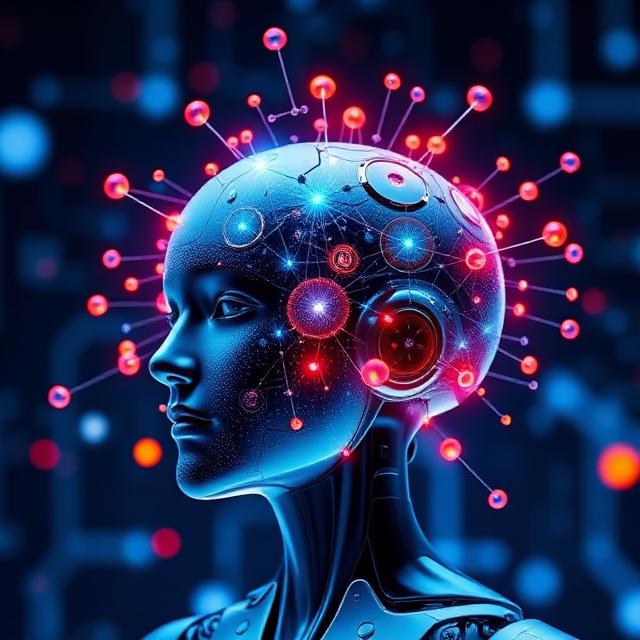

Marketing isn’t just adopting AI anymore — it’s being rebuilt around it. The tools that used to sit on the edge of a marketing team’s workflow (a chatbot here, an auto-generated caption there) are now running core parts of the strategy itself: audience targeting, bidding, content production, even entire campaigns, often with limited human input at each step.
If you’re wondering whether this is a passing trend worth waiting out, the data says otherwise. Here’s where digital marketing with AI is actually headed, and what it means for how you’ll need to compete.
Key Takeaways
- 88% of organizations now use AI in one or more marketing functions, up from 78% just a year earlier.
- 61% of marketers say the industry is experiencing its biggest disruption in 20 years.
- AI is changing how people search entirely — Google’s AI Overviews already reduce organic click-through rates by 18% on average, and up to 47% for informational queries.
- Teams that adopted AI content tools are now producing 4.1x more published content per marketer per month.
- 81% of CMOs expect to increase AI tool spending over the next year, with a median planned increase of 47%.
1. AI Adoption Has Moved from Experiment to Default
The debate over “should we use AI in marketing” is effectively over. Current data shows <cite index=”55-1″>88% of organizations deployed AI in at least one marketing function in the past year, up from 78% the year before</cite>, and separately, <cite index=”52-1″>75% of marketers now use at least one form of AI</cite> — whether predictive, generative, or agentic. Adoption is highest among the teams closest to daily content output: <cite index=”58-1″>content marketers lead internal adoption at 96%, followed closely by SEO specialists at 93%</cite>.
The scale of disruption isn’t subtle, either. <cite index=”52-1″>61% of marketers describe this as the industry’s biggest disruption in 20 years</cite> — not an incremental shift, but a fundamental change in how the work gets done.
2. Agentic AI Is the Next Frontier — and It’s Already Here
The next leap isn’t AI that suggests actions; it’s AI that takes them. Modern marketing platforms increasingly involve <cite index=”52-1″>multiple specialized AI agents working together — one for content production, one for audience targeting, one for performance reporting, one for media buying — communicating with each other through emerging coordination protocols</cite>.
This isn’t a future prediction; it’s already shaping budgets. A recent industry outlook study found <cite index=”52-1″>two-thirds of U.S. brand and agency buyers are now focused on agentic AI for ad buying and campaign execution</cite>. Looking further out, expect this to accelerate: platforms are moving toward <cite index=”57-1″>autonomous systems that don’t just suggest ads, but build them, buy the placement, and track performance on their own</cite> — shifting the marketer’s role from doing the work to directing the system that does it.
3. Search Itself Is Being Rebuilt Around AI
Perhaps the most consequential shift isn’t in how marketers work — it’s in how customers search. AI-generated answer summaries now appear directly in search results, and they’re already reshaping traffic. Google’s <cite index=”51-1″>AI Overviews now appear for roughly 15% of queries and synthesize answers from top search results, displaying above traditional organic listings</cite>. The traffic impact is measurable: this shift <cite index=”51-1″>reduces organic click-through rates by 18% on average, and by as much as 47% for purely informational queries</cite>.
This is giving rise to an entirely new discipline: optimizing not just for search engines, but for AI-generated answers themselves — often called Generative Engine Optimization (GEO). <cite index=”59-1″>Brands are increasingly optimizing for AI-driven answers instead of just traditional search rankings</cite> to stay visible as more discovery happens inside AI conversations rather than a list of blue links.
4. Hyper-Personalization Becomes the Baseline Expectation
Generic messaging is quickly becoming a liability rather than just a missed opportunity. Consumer expectations have shifted decisively: <cite index=”55-1″>71% of customers now expect personalized interactions from brands, and 76% report feeling frustrated when brands fail to deliver them</cite>.
AI is what’s making this scale of personalization possible. Rather than broad demographic targeting, AI systems now build far more specific audience segments — the kind of shift Improvado’s research describes as moving from targeting simply “men” or “women” to targeting <cite index=”57-1″>detailed behavioral groups like “frequent travelers who like organic coffee”</cite>. The financial stakes are real too: Statista projects that <cite index=”59-1”>AI-driven personalization will account for over 40% of all digital sales</cite> going forward.
5. Content Production Is Scaling Dramatically — But Quality Has a Ceiling
AI hasn’t just sped up content creation — it’s changed the math entirely. Teams that adopted AI content tools are now producing <cite index=”58-1″>4.1x more published content per marketer per month than before adoption</cite>, with the biggest gains concentrated in content marketing specifically at <cite index=”58-1″>4.6x</cite> and social media at <cite index=”58-1″>3.8x</cite>.
But more isn’t infinite. That same research found the growth curve <cite index=”58-1″>plateaus around month 12 to 15 of adoption, as teams hit quality ceilings rather than quantity ceilings</cite> — a consistent pattern across industries. In other words, AI removes the production bottleneck, but strategic judgment and quality control quickly become the new constraint.
6. AI Still Fails at Context Humans Take for Granted
For all its power, AI-driven marketing has clear failure modes — and they tend to show up exactly where human judgment matters most. In one documented case, a global brand let AI determine <cite index=”51-1″>optimal send times for a campaign across 22 countries based purely on historical engagement data</cite>. Performance held up in 21 markets, but in one region, <cite index=”51-1″>open rates dropped 68% and brand sentiment fell 12 points</cite> — because the AI scheduled the campaign for a national day of mourning, a cultural event its training data never captured.
The lesson generalizes well beyond that one incident: <cite index=”51-1″>AI excels at pattern recognition within its training data but struggles to reason about unstructured context — cultural events, offline crises, regulatory shifts</cite>. Human judgment isn’t becoming obsolete; it’s becoming more concentrated in exactly these edge cases.
7. The Marketer’s Job Is Shifting from “Doing” to “Directing”
As AI absorbs more of the repetitive execution work, the human role in marketing is moving up the stack. Time savings from AI adoption are already substantial and measured directly: marketers report saving <cite index=”58-1″>an average of 6.1 hours per week</cite>, freeing up meaningful time for strategic work AI still can’t reliably do.
This is reshaping hiring, too — not through wholesale headcount cuts, but through a shift in composition. While overall marketing headcount is holding roughly steady, <cite index=”58-1″>23% of agencies reduced junior copywriter roles in the past year, with 31% planning further reductions</cite> — a signal that entry-level execution work is exactly where AI is displacing humans fastest, even as strategic and oversight roles grow in importance.
8. Budgets Are Following the Shift, Not Just the Hype
Executive confidence in AI marketing spend has moved past the skepticism of a few years ago. Current data shows <cite index=”58-1″>81% of CMOs expect their AI tool spending to grow over the next 12 months, with a median planned increase of 47%</cite>. Only a small fraction plan to cut AI spending, and even then, it’s typically about consolidating overlapping tools — not reduced commitment to the technology itself.
What This Means for Your Business
The future of digital marketing with AI isn’t a single tool or tactic — it’s a fundamental restructuring of how strategy, execution, and search all work together. Businesses that treat AI as a bolt-on feature for occasional content generation are already behind. The ones pulling ahead are rebuilding their entire marketing function — from search visibility to personalization to production — around AI as the operating layer, with human judgment concentrated where it matters most: strategy, ethics, brand voice, and the messy real-world context AI still can’t fully grasp.
7 Steps to Prepare Your Marketing for an AI-Driven Future
- Start optimizing for AI-generated answers, not just search rankings. As AI Overviews and conversational search grow, visibility inside AI-generated responses will matter as much as your position in traditional results.
- Audit where AI can realistically scale your content production — and where human review still needs to sit before publishing, especially for anything culturally or emotionally sensitive.
- Invest in genuine personalization infrastructure, not just first-name email merges. Behavioral and intent-based targeting is quickly becoming the baseline, not a differentiator.
- Pilot agentic AI in narrow, measurable use cases first — ad bidding or reporting automation, for example — before expanding to broader campaign execution.
- Build human-in-the-loop checkpoints for anything involving cultural context, sensitive timing, or brand reputation, where AI has clear documented blind spots.
- Reallocate freed-up time toward strategy and oversight, not just more output. The real advantage isn’t producing more content; it’s producing the right content faster.
- Track your AI ROI by use case, since returns vary significantly by application — broad “we use AI now” adoption isn’t the same as measurable performance gains.
Frequently Asked Questions
Will AI replace marketers entirely? Current data doesn’t support that. Overall marketing headcount is holding roughly steady even as AI adoption grows, though the composition of roles is shifting — junior, execution-heavy roles are seeing the most reduction, while strategic and oversight roles are becoming more valuable, not less.
What is Generative Engine Optimization (GEO), and do I need it? GEO refers to optimizing content to be surfaced and cited by AI-generated search answers (like Google’s AI Overviews or conversational AI tools), rather than just ranking in traditional search results. As AI-generated answers increasingly appear above organic listings and measurably reduce click-through rates, GEO is becoming a necessary complement to traditional SEO, not a replacement for it.
Is agentic AI actually being used in marketing yet, or is it still theoretical? It’s already in active use. A majority of brand and agency ad buyers report focusing on agentic AI for campaign execution and ad buying today, not as a future plan — though most implementations remain scoped to specific tasks rather than fully autonomous campaigns.
How much should a business budget for AI marketing tools? There’s no universal number, but the trend is clearly upward — most marketing leaders plan meaningful increases in AI tool spending, and very few are pulling back. The more useful benchmark is tracking return by specific use case rather than treating AI spend as one undifferentiated line item.
Final Thoughts
The future of digital marketing with AI isn’t arriving — it’s already here, and it’s moving faster than most marketing organizations are structurally prepared for. The businesses that will win aren’t the ones adopting every new AI tool as it appears. They’re the ones building disciplined systems: AI handling scale and speed, humans handling judgment and context, and clear measurement tying it all back to actual results.
The gap between those two approaches — reactive tool-chasing versus deliberate AI strategy — is where the real competitive advantage will sit over the next few years.
Not sure where AI fits into your marketing strategy yet? [Contact us today] and we’ll help you build a roadmap that separates the real opportunities from the noise.





Leave a Comment